
Role
Global UX/UI Design Intern
Team
1 UX/UI Manager
3 Senior Designers
1 UX Writer
3 Marketing Scrum Teams
Timeline
8 Months
Overview
On Universal's Global UX/UI Design team, I worked closely with 3 marketing Scrum teams on seasonal campaign content for Universal Orlando Resort and Universal Studios Hollywood’s consumer-facing websites & apps, while supporting usability testing for a new Universal Play experience that launched in March 2025.
Results
Shipping ~30+ webpages across 3 major seasonal event campaigns contributed toward increased brand visibility + ticket sales at the Orlando + Hollywood parks throughout 2024
Implementing 5 evergreen UX content strategies across Islands of Adventure's attraction webpages on Universal Orlando's site contributed to increased user engagement on Discover Universal
Documentation enabled ~4+ teams (Global UX/UI, 3 marketing Scrum teams, and various external vendors) to align on projects more quickly
Context
Universal's online presence is critical to revenue generation

With high park attendance every year, seasonal campaigns at Universal’s parks drive ticket & resort package sales through web & app platforms.

Speed & consistency were key for launching promote seasonal park events and e-commerce campaign webpages on schedule.

Multiple teams — internal & external — worked on the same projects, but varying team processes caused pushback and delayed launches.
To get a glimpse of the impact & scale of Universal’s seasonal campaigns, here’s how many visitors Universal’s U.S. parks saw in 2024:
21M+
Annual visitors across Universal Orlando Resort
8.7M+
Annual visitors at Universal Studios Hollywood
Define
How might we align multiple teams quickly to launch seasonal campaign content on Universal Orlando & Hollywood’s websites on schedule?
Process
While senior designers on the team were assigned to 1 Scrum team, I supported all 3 Scrum teams simultaneously. I was context switching between different projects each team was working on, allowing me to understand how each team worked quickly. The core challenge wasn't just designing screens, it was getting at least 4 teams (my team, 3 marketing Scrum teams, and various external vendors) aligned quickly enough to hit campaign launch dates on schedule.

Early into my internship, I noticed frequent pushback between teams during project sprints. Internal teams had inconsistent handoff expectations and external teams did not have enough clarification on image optimization for third party hotel & travel agency websites. A senior designer on my team had already identified these issues and started creating documentation on Confluence, but it was unfinished due to time constraints.
My team considered 3 options:
Do nothing.
With so many moving parts across a global org, resolving conflict between teams in meetings wasn't always prioritized.
Why we rejected this: Continuing without cross-team alignment meant delays would repeat on every campaign sprint. Not viable in the long run.
Full workflow overhaul
Create a unified SOP from scratch for every team working on B2C web/app campaigns — a "hard reset" for each team's workflow.
Why we rejected this: Getting every team aligned on an entirely new process would be very time-consuming at the scale Universal operates, so it realistically couldn't happen.
Finish the documentation!
Being mid-migration from Sketch → Figma and internal team resources moving to SharePoint, the push for formal documentation revived within the team.
Why we chose this: The most time-efficient. The senior designer delegated the documentation to me while staying focused on leading design projects.
Solution
I worked closely with the senior designer to author documentation on standard operating processes for marketing Scrum team projects while ensuring it would become a single source of truth for working on new projects. The documentation most notably included:


01
Refreshed Project SOPs
Explicitly enforces existing workflow across multiple teams
02
Image Optimization Guidelines
Specifies safe zones & image dimensions for internal team & external vendor use
03
Figma Best Practices
Reinforces design system best practices within Figma for UX/UI team members working on projects mid-migration
Impact: Selected Work
Leveraging the documentation myself enabled me to ship my own work faster, including:
01
Three major seasonal event campaigns
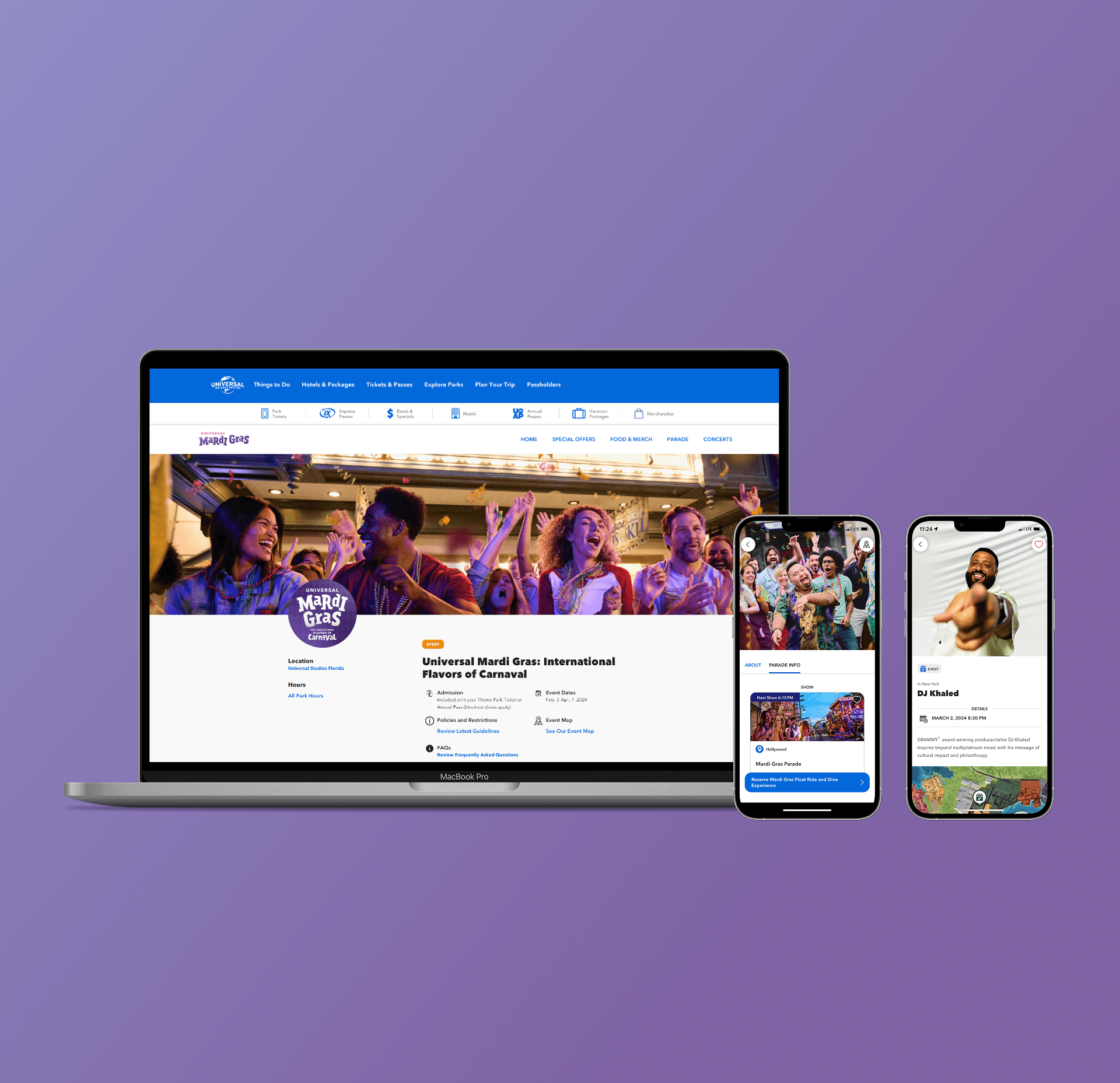
Using the refreshed work processes, I shipped ~30+ web & app screens across 3 major seasonal campaigns at the Orlando & Hollywood parks:
Universal Mardi Gras: Universal Orlando Resort, live Feb-Apr 2024
Studio Tour 60th Anniversary: Universal Studios Hollywood, live Apr-Aug 2024
Halloween Horror Nights 33: Universal Orlando Resort, live Aug-Nov 2024
02
Discover Universal integrations
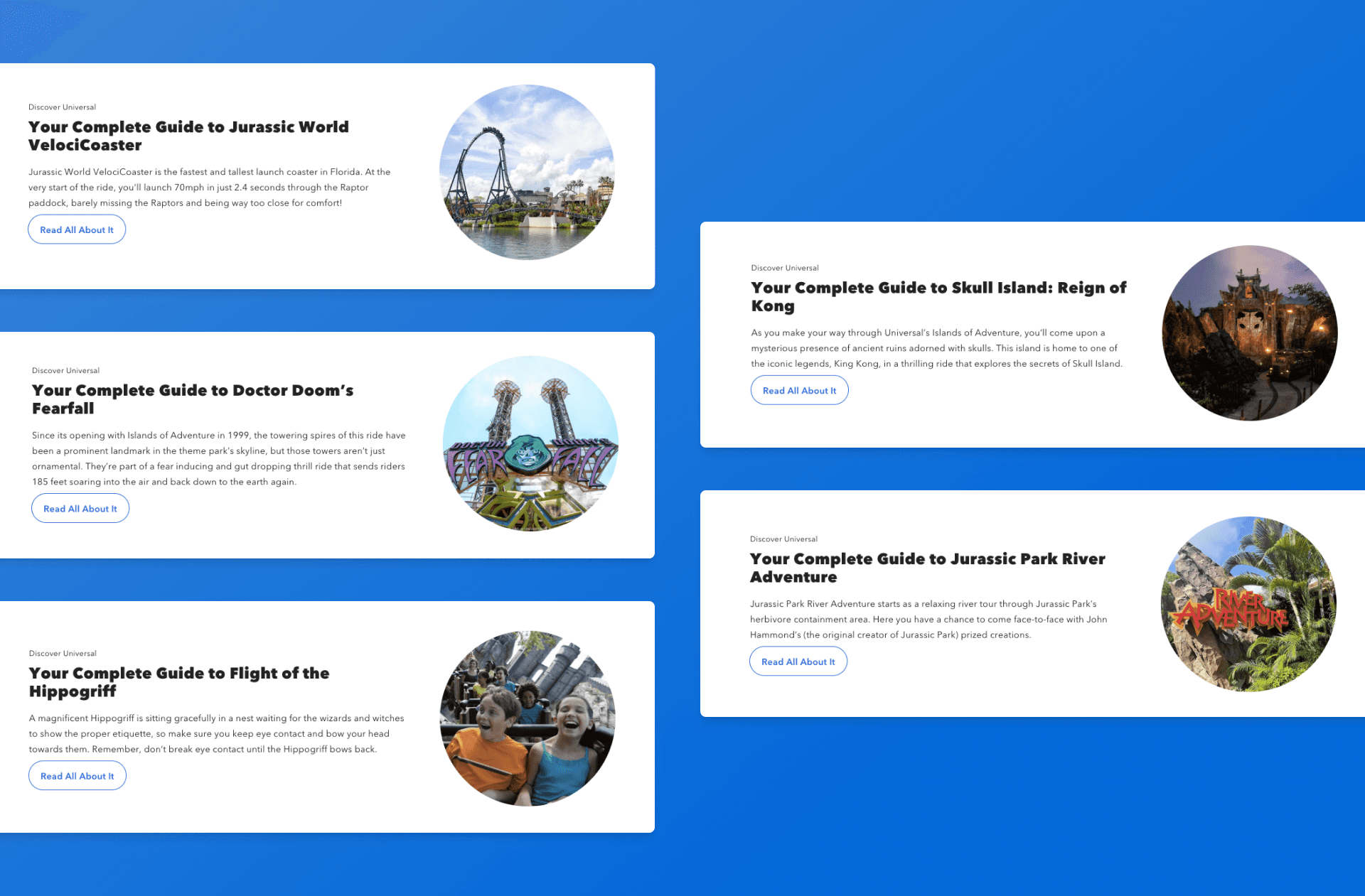
In addition to campaign pages, I integrated content that served as a call-to-action for users to visit Discover Universal across 5 Islands of Adventure attraction pages (all went live in late 2023):
Jurassic World VelociCoaster
Doctor Doom's Fearfall
Flight of the Hippogriff
Skull Island: Reign of Kong
Jurassic Park River Adventure
This required balancing marketing goals with user discovery patterns. The goal was to increase consumer engagement while providing SEO a clearer path to publish evergreen content.
Results
Increased cross-team efficiency
The documentation for Global UX/UI & collaborating teams helped ensure campaigns went live on-schedule:
Fewer design review cycles
Teams following more unified working processes helped decrease pushback.
Faster project handoffs
External agencies could reference the image guidelines directly, eliminating back-and-forth on asset specs.
Streamlined design system migration
Having more standardized best practices for using GDS saved time when designers started using Figma for shipping projects.
Side Quest
Testing a new spellbinding experience
Throughout my internship, I also had the opportunity to support 2 senior designers with conducting usability testing a new Universal Play experience, which launched across the Wizarding World of Harry Potter at Universal Orlando Resort in 2025. We facilitated initial sessions in-office before conducting large-scale play test sessions with teams at Universal Creative.
Being my first formal experience with UX research in my career, being involved in usability testing for this experience reinforced how crucial early user feedback is for designing products that involve multiple stakeholders.

Onboarding and pairing a Wand in the Wizarding World of Harry Potter's Universal Play app
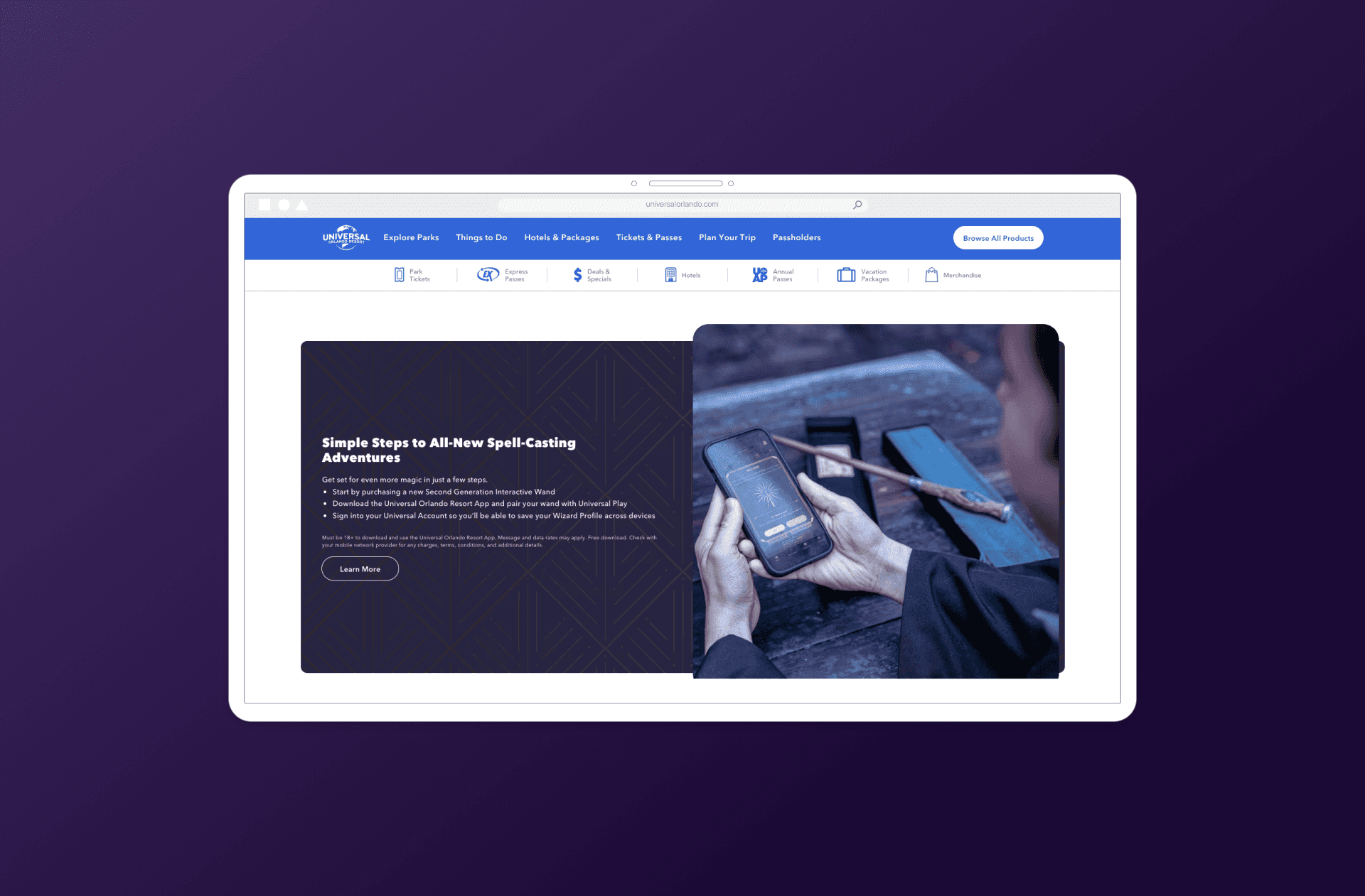
Information on using the Universal Play experience with the new Wands on Universal Orlando Resort’s site
Learnings
Design is solving business needs, not pushing pixels
Seasonal event campaigns at the Orlando & Hollywood parks have fixed launch dates, fixed budgets, and success metrics (e.g. ticket sales, number of annual visitors). I realized being in UX meant being the connective tissue between teams, so understanding why a feature was being built helped me make smarter design decisions aligned with what stakeholders were looking for.
Document everything (to focus on the things that matter)
Early on, I noticed pushback between teams during handoff. Instead of just absorbing the chaos, I embraced opportunities to create new solutions: templates, guidelines, checklists. Despite how trivial they seem, they let teams knock out the low-level work so designers can get to crafting meaningful design solutions faster. Documentation has since become core part of my design approach.
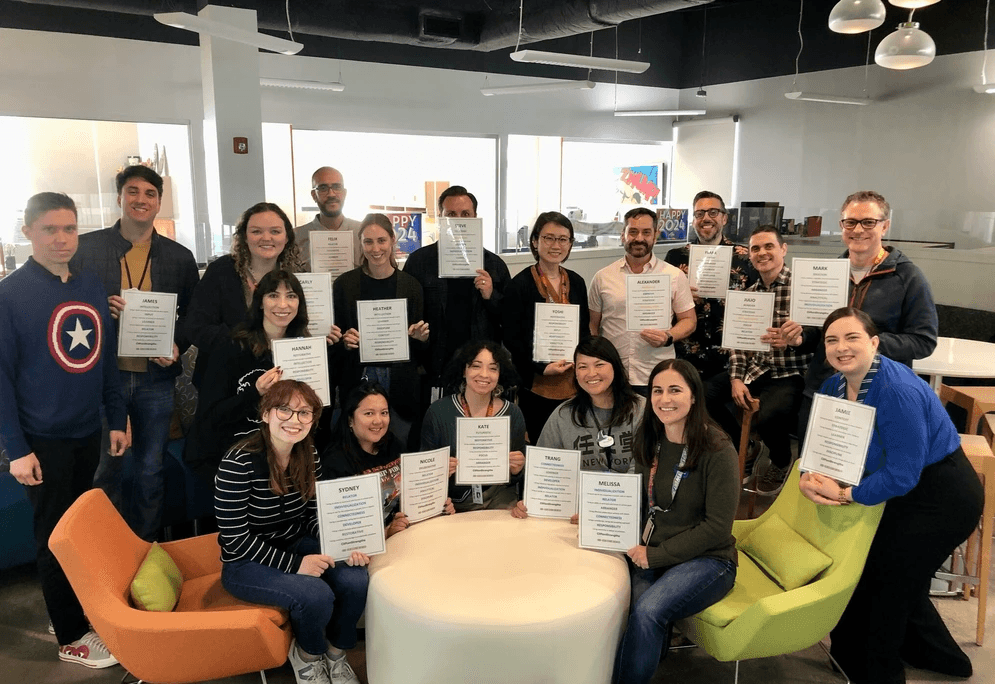
Special thanks to the Global UX/UI team — I’ve learned so much from you all!

My intern cohort in spring 2024!