Role
Lead Product Designer
Team
Greg Leibowitz / Design Mentor
Timeline
3 Months
Overview
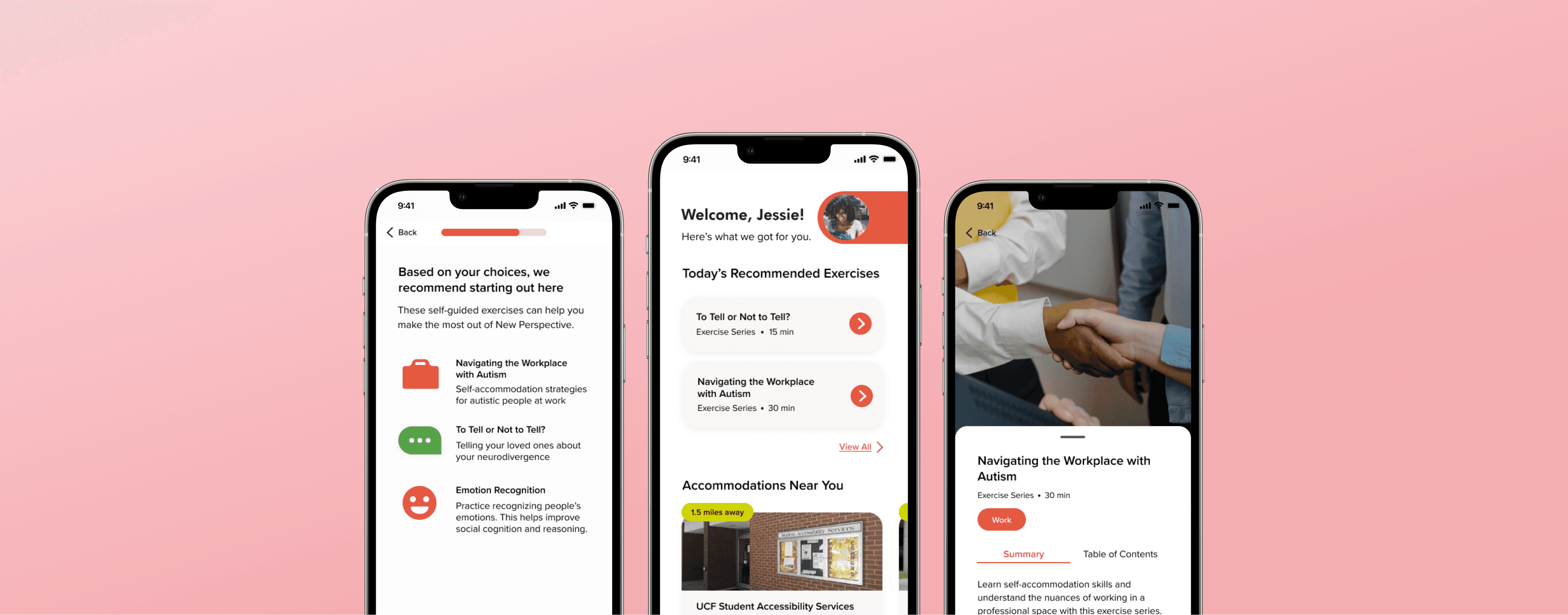
I led product design and creative direction for New Perspective, a discreet self-service resource app for the neurodivergent community. It targets one of the fastest-growing, most underserved demographics in the United States: neurodivergent adults who were diagnosed late and those who do not want to reveal their diagnoses in public settings.
Results
If shipped, the following would be used to measure user behavior: onboarding-to-first-Exercise conversion, Exercise completion rate, return visit rate, and Find College Accommodations engagement.
New Perspective won Best of Show at AIGA Orlando's 2024 SPOT Showcase, selected from an exhibition of 15 projects.
Context
Many resources exist for helping neurodivergent children & teens, but what about neurodivergent adults?

Searching autism and ADHD resources on Google primarily yields resources for parents of neurodivergent children & teens. Neurodivergent people themselves are largely on their own.

Major neurodiversity orgs (e.g. Autism Speaks) frequently depict neurodivergence as a childhood problem — "a disease that needs to be cured" early on in childhood or else they will be “lost cause”.

As more research is being done on neurodiversity and how it manifests in people, many neurodivergent adults are diagnosed later in life (ex: Over 50% of Americans with ADHD are diagnosed in adulthood!).
Research
The real barrier isn’t incapability — it’s silence
29
Survey participants
Over 80%
of participants do not communicate their needs to others.
Common Reasons Cited
Higher likelihood of getting fired at work
Not wanting to be perceived differently or be discriminated against (ableism)
Stigma surrounding getting accommodations
Notable Pain Points

In general: Do not publicly disclose diagnosis (70%)

At work: Job interviews & managing workload (70%)

In class: Asking their professors for help (60%)

With others: Making friends & keeping them (90%)
Key Insight
People knew what they needed, but they have learned that saying so came with consequences.
I don't tell people at jobs about my brain because they don't care. […] Asking for accommodations is just asking to get fired, so in the workplace I just suffer. I find it easy to talk to customers because I know the interaction is temporary.
Participant with AuDHD
On being at work
The hardest thing for me in school was self confidence. I would feel like I was a fraud and didn't know as much as my classmates. […] Me not taking care of myself would snowball into poorer time management and increasing my own workload.
Participant with ADHD
On college classes
It's important to explain [things] regularly, so people understand where you are coming from. It makes it much easier to understand why you might do or say certain things.
Participant with autism
On friendships
Both partners being clear about needs helps [each other] know what to expect, what will help the other person feel cared for, and avoid unintentional harm or misunderstanding.
Participant with AuDHD
On relationships
[…] I tend to forget things and can space out at times. I want people to know that I care and am not bored. It's also hard to manage since I at times will forget to take my medication.
Participant with ADD
On living with neurodivergence
Define
How might we create a resource tool for a group of people who have learned that asking for help has consequences?
Connect CMS Image fields (Image 1–10)
Process
Design decisions were primarily made before designing anything in Figma. To determine content strategy & app features, I did a MoSCoW prioritization exercise:

Based off of my “Must Have” items of MoSCoW, I decided to have the app utilize a self-serve resource model. Here are some notable design decisions:
Self-guided exercises
Makes resources & other information easier to learn & retain for users.
Why I chose this: Neurodivergent users can use the app to get the help they need on their own time — without disclosing their diagnoses. This can greatly benefit neurodivergent people who aren't comfortable requesting accommodations at work or school.
Community forum
A community forum feature inspired by Reddit’s Subreddits was considered to foster a sense of belonging & support among users.
Why I rejected this: Due to ambiguity on whether users would actually use this feature, this was left out. If a community forum feature was to be added, further surveying and/or interviews with neurodivergent adults would be necessary before implementing this.
Gamification elements
Gamification elements were considered in order to make the app more engaging for neurodivergent users and help them remember information & resources more easily.
Why I rejected this: Can shift focus away the app’s main purpose (being a resource hub). There are also predatory practices associated with gamification, instilling FOMO for users or even driving them away.
Connect CMS Image fields (Image 1–10)
Creative Direction
When visual language is the first barrier
Creative direction was treated as a UX decision from the start. Major neurodiversity orgs often signal "this is for children" through branding alone: puzzle pieces, primary colors, and clinical language. Families & mental health professionals may not have a problem with that, but for neurodivergent adults the wrong visual language is enough to tell them "this isn't for you". Because of that, New Perspective's visual language intentionally avoided these aesthetics for its branding.
Connect CMS Image fields (Image 1–10)
Final creative direction

Initial branding explorations

Final branding moodboard

Logo construction
Solution
New Perspective: A discreet resource built for neurodivergent adults
01
Personalized (yet anonymous) user onboarding
A short onboarding quiz personalizes New Perspective for every user, curating exercises & accommodation resources.
Because many neurodivergent adults do not want their diagnosis to be known publicly, users are not required to report their diagnoses to the app.
In other words: The app simply asks users where they are.
02
Bite-sized exercises for real situations
Users can take self-guided exercises to learn self-accommodation & coping strategies for work, college classes, and personal relationships.
Content is structured in bite-sized formats, making coping strategies easy to learn — particularly helpful for users who may be dealing with these situations alone.
03
Finding local college accommodations
Many neurodivergent adults (particularly those recently diagnosed) don't know what accommodations they're entitled to, let alone which institutions offer them.
New Perspective's Find College Accommodations feature addresses this by helping users locate local colleges and displaying relevant accommodations based on the user’s onboarding quiz answers.
04
Learn & advocate for your needs
Survey findings showed participants are willing to open up to their friends & romantic partners (90% of respondents), but they still struggle to articulate their needs.
The Learn About Neurodiversity feature addresses that directly: helping users understand their own brain first, so they can communicate what's actually going on rather than leaving their loved ones to guess.
Design System
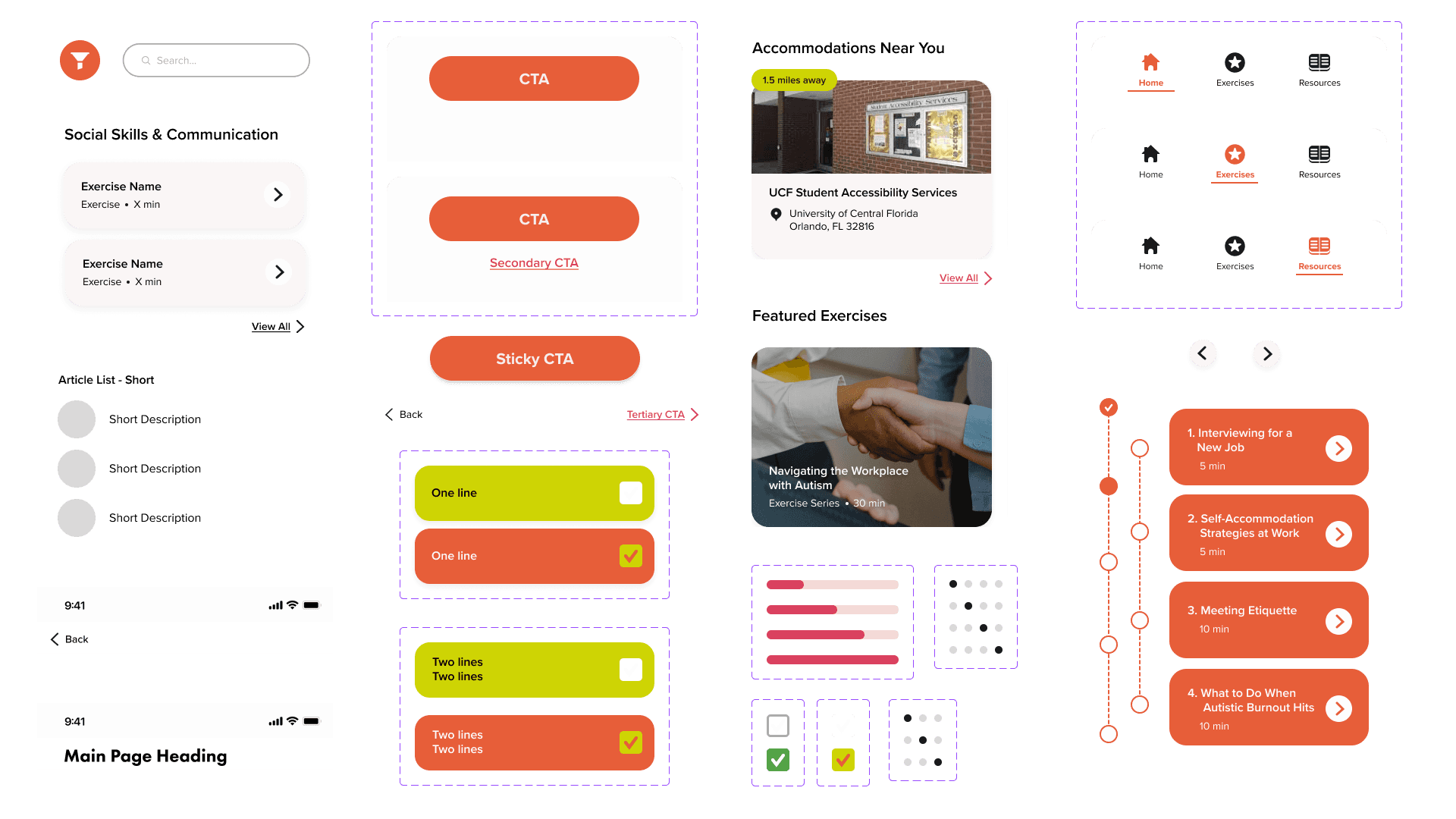
The UI was built using an atomic design approach and clear, plain-language content writing throughout. This ensured the app was legible and easy to navigate for users with cognitive disabilities.
Results
How would success be measured?
Without live data, success metrics would focus on user behavior over self-reported satisfaction:
Onboarding-to-first-exercise conversion: Does the quiz successfully move users in?
Exercise completion rate: Are users finishing modules or dropping off before getting value?
Return visit rate: A self-service resource tool will either live or die on whether people come back — how effective is it?
Accommodations locator engagement: Would users be more engaged if accommodations from other places (e.g. restaurants, stores) are listed alongside colleges?
Local industry recognition
New Perspective won Best of Show at AIGA Orlando's 2024 SPOT Showcase, selected from an exhibition of 15 projects! The judging panel flagged the app's product positioning specifically; one judge with ADHD could even identify the app's intentional distancing from conventional neurodiversity orgs immediately.

Learnings
Crafting content strategy with empathy
Designing directly for neurodivergent adults — not their families — meant constantly pressure-testing content decisions against the community's actual needs. Content strategy requires actively questioning whether piece of content is really serving its target audience.
Designing with intention means knowing what to reject
The most important design decisions on this project were rejections, especially when establishing New Perspective’s creative direction. Intentional design here meant understanding the harm of existing defaults well enough to avoid them.
Want to learn more?
I'd love to talk more about my design process over a call!